Forget the abstract notion of silicon architecture for a moment. What this news from CAST actually means for you, the engineer or product manager, is greater flexibility and drastically reduced risk when specifying serial memory for your next complex design. It’s about finally bringing order to the chaotic sprawl of proprietary serial memory interfaces that have long plagued engineers trying to hit cost targets and aggressive development timelines.
The SPI interface, bless its four-wire heart, has been a workhorse for decades, connecting everything from simple sensors to sophisticated processors. But the way memory manufacturers implemented their own command sets over SPI led to a splintered ecosystem. You’d pick a memory chip, only to find its command set was unique, demanding custom software stacks and creating nightmares for supply chain flexibility. This fragmentation was, frankly, inefficient.
The xSPI Solution: Standardization at Last?
JEDEC’s xSPI standard was the industry’s answer, an attempt to corral the most popular proprietary protocols under one umbrella. Now, with xSPI adoption reaching a critical mass, CAST’s new xSPI-MC IP core arrives, promising a consolidated protocol engine and memory controller. The kicker? It’s functional safety (FuSa)-ready.
This isn’t just about moving data faster; it’s about doing so reliably in environments where failure isn’t an option. Think automotive engine control units (ECUs) or advanced driver-assistance systems (ADAS). These applications demand ISO 26262 compliance, and the xSPI-MC core, with its built-in redundancies and CRC protection, is designed to ease that arduous certification process.
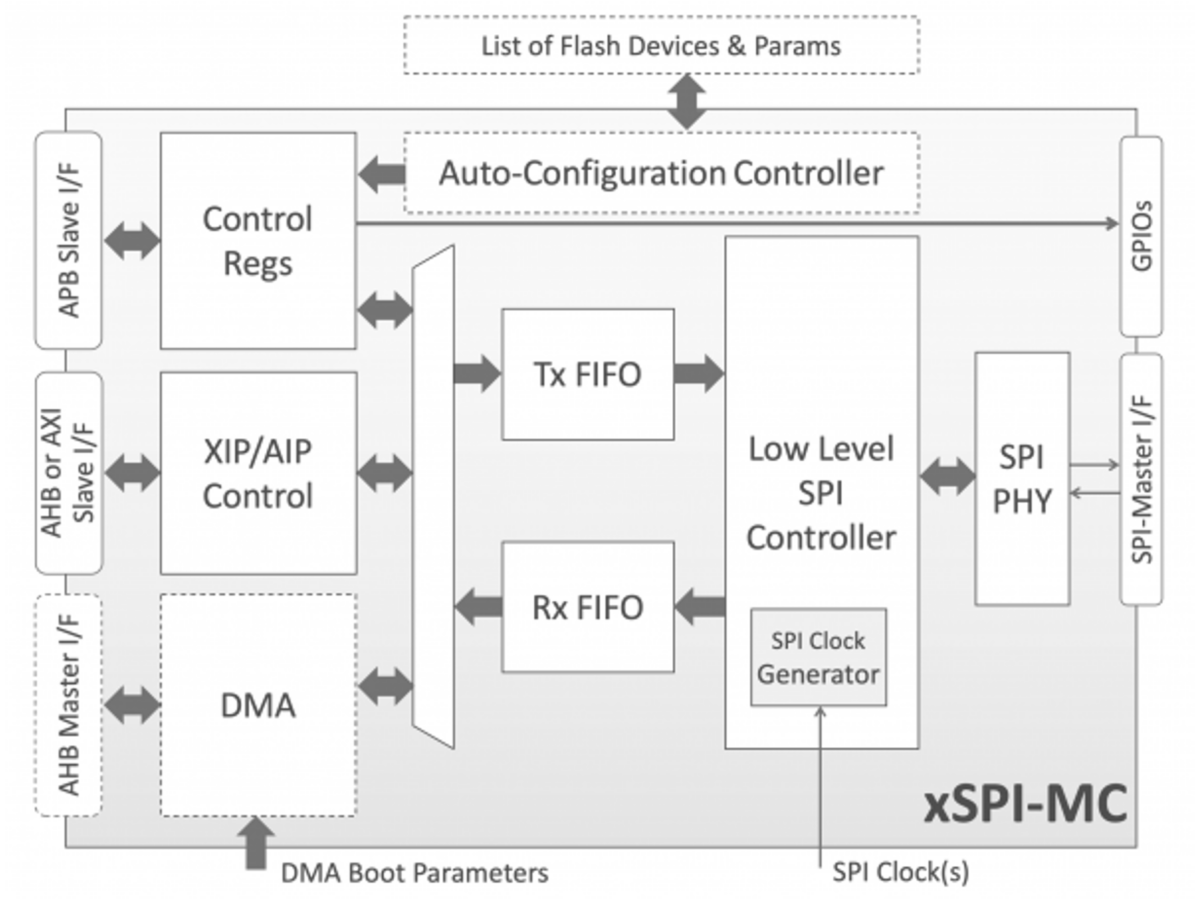
CAST’s xSPI-MC IP core is an attractive offering that blends a protocol engine and a serial memory controller in functional safety-ready configurations that are fully synthesizable and suitable for practically any serial flash or serial PSRAM application.
And here’s the pragmatic part for design engineers: the configurability. The ability to detect and auto-configure to various memory devices at runtime, with zero software overhead, is a project-saver. Picture this: you’re weeks from tape-out, and the selected memory part becomes unavailable due to a supply chain crunch or price hike. Instead of a full redesign, the xSPI-MC’s external device ID table (residing in ROM or OTP) can be updated, allowing you to swap in a different, compliant memory device without a massive headache. This is the kind of flexibility that keeps projects on schedule and budgets intact.
Beyond the Protocol: The Soft PHY Advantage
The physical interface (PHY) is often an overlooked but critical component. CAST’s approach here—a soft PHY specifically tailored for SPI—is a strategic move. Unlike rigid hard PHYs tied to specific process nodes and requiring extensive analog bring-up, this synthesizable RTL offers unparalleled portability. It can be dropped into virtually any ASIC or FPGA flow, across any foundry or process node. This dramatically reduces foundry dependencies and schedule risks, a significant win in today’s volatile manufacturing landscape.
It supports a spectrum of SPI buses—single, dual, quad, octal, and even 16x—and integrates with other high-speed serial memory interfaces like HyperBus and Xccela. This broad compatibility means a single IP core can potentially serve multiple product lines, simplifying verification and software development efforts across an organization.
The Bottom Line: Pragmatism Over Hype
While the industry often gets caught up in the latest AI accelerator or quantum computing buzz, the humble but essential task of reliable embedded memory control is quietly being revolutionized. CAST isn’t claiming to invent the next big thing in AI compute; they’re delivering pragmatic, strong solutions for foundational technologies that power critical systems. The functional safety readiness is key. It signals a mature understanding of where the embedded market is heading: increasingly demanding applications requiring stringent reliability and security, all while pushing for greater design efficiency and supply chain resilience.
This isn’t about chasing shiny objects. It’s about providing the building blocks that make complex, safe, and reliable systems a reality for engineers on the ground. The market dynamics are clear: as embedded systems permeate more safety-critical sectors, the demand for certified, flexible, and efficient IP cores like CAST’s xSPI-MC will only intensify.
🧬 Related Insights
- Read more: RISC-V vs ARM vs x86: Instruction Set Architectures Compared
- Read more: SNIA’s MRAM Alliance SIG: Ecosystem Push or Hype? [2026]
Frequently Asked Questions
What is xSPI?
xSPI is a superset standard developed by JEDEC that aims to unify various proprietary serial memory protocols built on top of the original SPI interface, allowing for better interoperability and performance.
Is this IP core suitable for FPGAs?
Yes, the CAST xSPI-MC IP core features a soft PHY implemented in fully synthesizable RTL, making it suitable for integration into both ASICs and FPGAs without requiring analog bring-up procedures.
What are the benefits of functional safety readiness?
Functional safety readiness means the IP core is designed with features and methodologies that help meet stringent safety standards like ISO 26262, crucial for applications in automotive, medical, and industrial control.