Ever wonder if your fancy new chip is really doing what it says on the tin, deep down in the silicon trenches? We’ve got X-rays for structure, sure, but watching the actual electrical dance of transistors while they’re hot and bothered? That’s been a real headache. Until now, maybe.
Researchers down in Adelaide, Australia – not exactly Silicon Valley central, but hey – are touting a new method using terahertz waves. Think less Superman’s vision, more a really sophisticated, non-contact eavesdropping. They claim they can observe electrical activity inside working chips, right through their packaging, and without messing with the delicate electrical ballet.
Why should you care? Because the current ways we prod and poke chips to see if they’re alive and kicking – things like invasive electronic probes or even X-rays – are either clumsy or just show you a pretty picture of the hardware, not the performance.
This terahertz gig, if it ever gets out of the lab and onto the factory floor, could shake up chip testing. “We built the system with off-the-shelf components,” says Professor Withawat Withayachumnankul, big cheese on this project. Sounds nice and accessible, right? But then he adds, “It requires line-of-sight, but it can penetrate chip packaging materials that are non-metallic.” Line-of-sight is a bit of a buzzkill if your chip is buried deep in layers of metal, which, let’s face it, many modern ones are. So, “off-the-shelf” for a university lab is a far cry from mass production.
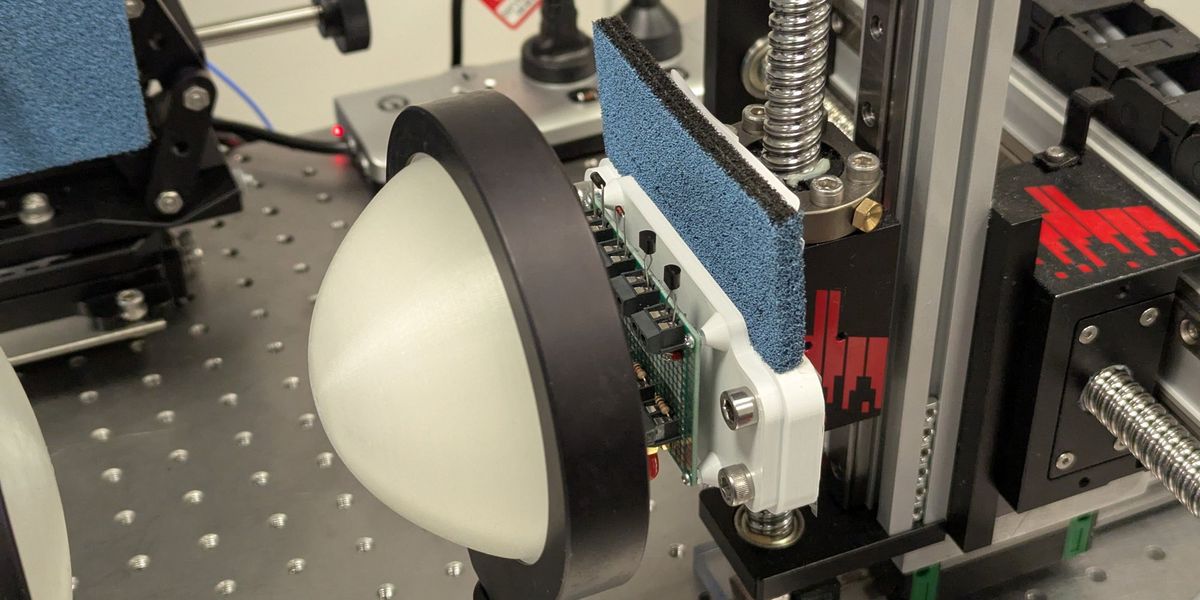
How does this magical terahertz probe work? You fire a microwave signal at a special gizmo that cranks it up to terahertz frequencies. This beam then zips towards your chip, focused down to a tiny spot – about a square millimeter. When the transistors inside do their switching thing, they subtly alter this terahertz signal. It bounces back, gets converted back to a more manageable microwave frequency, and then—here’s the brainy bit—gets compared to the original signal.
By sniffing out the minuscule changes in amplitude and phase, these eggheads can deduce what the electrical charge is doing. More charge carriers? A stronger reflected signal. Simple, in theory.
“I’m not aware of any inspection technology that can do this. That’s exciting”
The real secret sauce seems to be a homodyne quadrature receiver. This fancy gadget, normally used for less extreme frequencies, is apparently a superstar at picking up faint whispers from the terahertz realm. They had to “hack it” to make it work, which, you know, always screams “ready for mass adoption.” The noise from the original signal generator is a huge problem at these frequencies, so comparing the reflected signal to the original is key to cancelling out that background chatter. “Homodyne detection is critical here,” chimes in Daniel Mittleman from Brown University, a known quantity in this space. “It is what allows one to detect the changes in the terahertz signal imposed by the much lower-frequency megahertz electrical modulation…” Yeah, it’s clever. It’s very clever.
So, it can see through plastic and ceramic packaging, it’s non-ionizing (read: safer than X-rays), and it can measure the chip while it’s working. Sounds like a dream, right? Except for that nagging doubt: what about the multi-layered sandwiches of metal that make up modern processors? Mittleman wisely points out, “It’s not clear that these layers are all transparent to terahertz radiation.” Uh oh.
This is where my 20 years of watching tech fads kick off and fizzle comes into play. Every few years, someone invents a new way to look at silicon. We’ve had optical methods, electron microscopy, advanced X-rays. They all promise to revolutionize testing. But the reality? The old ways, the established, albeit imperfect, methods usually stick around because they’re reliable, understood, and, crucially, they work at scale and at a cost that makes sense for companies churning out billions of chips.
Will terahertz waves become the new standard? Possibly, for niche applications. For spotting a specific flaw, maybe. But for the daily grind of high-volume chip manufacturing, where every second and every dollar counts? I’ll believe it when I see it without a specialized lab setup and a team of physicists to operate it.
Who’s making money here? Right now, probably just the folks selling the “off-the-shelf” VNA frequency extenders. The actual chip manufacturers aren’t rushing to retool their multi-billion dollar fabrication plants based on a lab experiment. It’s an interesting scientific paper, a promising direction, but let’s not start planning the farewell tours for current chip inspection methods just yet. It’s a neat trick, but the real test is whether it can pay the bills.
The Packaging Problem Persists
While the terahertz method boasts the advantage of penetrating non-metallic packaging—a definite plus compared to some older techniques that might require chip decapsulation—its utility can be severely limited by the very nature of modern chip architectures. Many advanced processors aren’t just single layers; they’re complex, stacked sandwiches. If terahertz waves can’t slice through those complex internal layers, particularly metal interconnects, then the ‘seeing through’ advantage becomes somewhat moot for the chips that matter most.
Beyond the Lab: A Glimpse of the Future?
It’s easy to get excited by shiny new tech that promises to peek into the black box of semiconductor operations. Terahertz imaging isn’t new, but its application to in-situ electrical activity of transistors is certainly novel. The Adelaide team’s success in hacking a homodyne receiver for this purpose is commendable. However, translating this from a controlled university environment to the chaotic, cost-sensitive world of mass chip production is a monumental leap. Think about the calibration, the environmental controls, the sheer speed required for billions of transistors. This is less a production line solution and more a sophisticated research tool for now. The real question isn’t if it can be done, but when and at what cost will it become economically viable for the foundries that dictate the industry’s pace.