The air in the PC component aisle always smells faintly of desperation and cheap plastic. It’s where hope goes to die, or at least get a significant discount.
And here we are again, staring down the barrel of the sub-$100 CPU market. Apparently, despite all the fancy talk about AI chips and $1,000 GPUs, some folks still just want to play Counter-Strike without mortgaging their kidney. Bless their hearts.
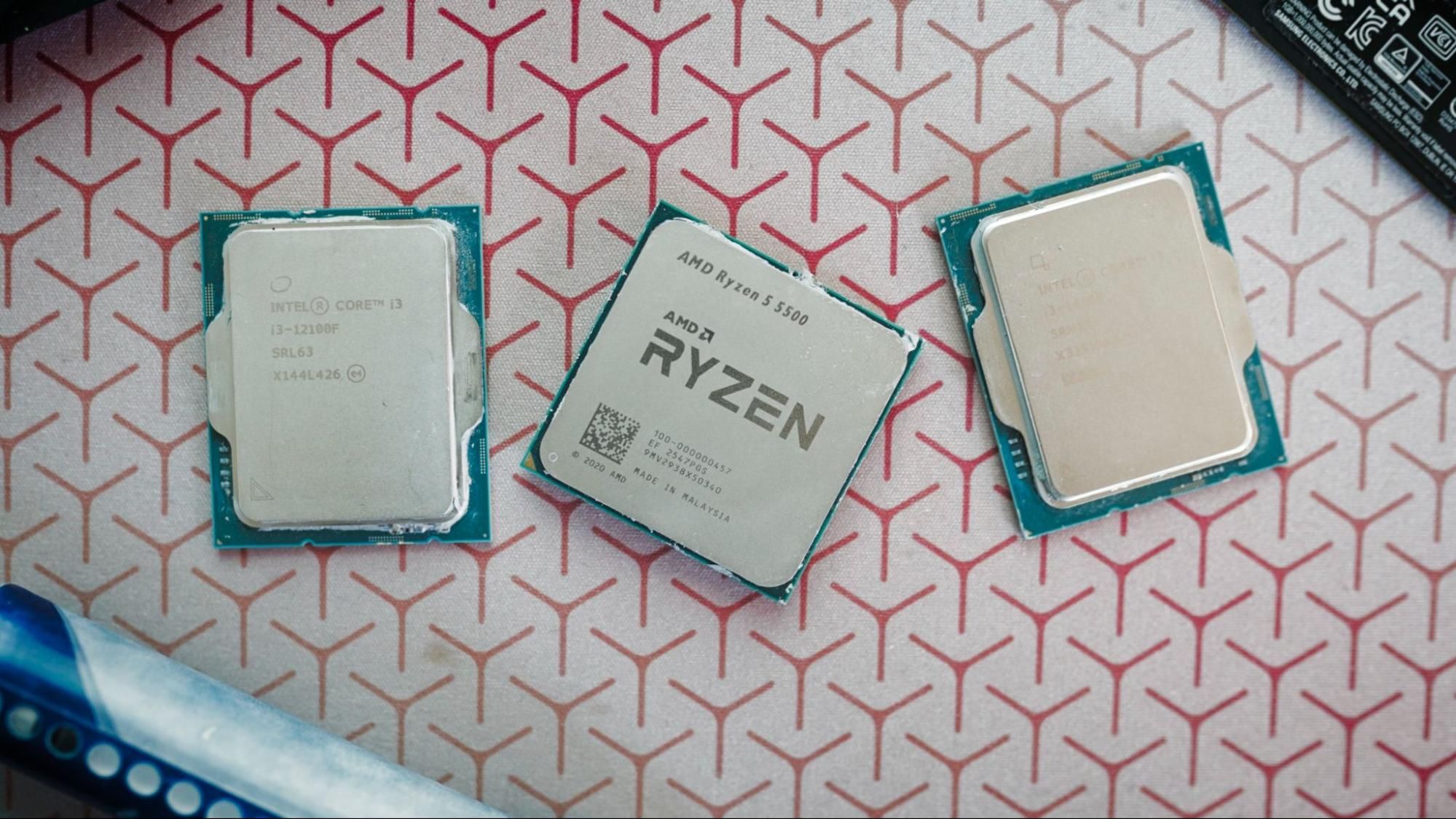
So, we’ve got the usual suspects: AMD’s Ryzen 5 5500, hovering around $80, and Intel’s twin Core i3s, the 12100F at $90 and the slightly-newer-on-paper 14100F for a crisp $100. Forget digging through dusty eBay listings for some ancient i7 or a Ryzen 3 that’s seen better decades. This is about buying something new, something that won’t immediately make your motherboard weep.
This segment, the one that doesn’t involve a second mortgage, is surprisingly stubborn. AMD’s Ryzen 5 5500, for whatever reason, is apparently the second-best-selling CPU on Amazon. Let that sink in for a moment. A chip that feels a generation or two behind, outselling… well, a lot of things.
And it’s not like this budget bracket is getting a lot of love from the big two with their bleeding-edge silicon. They’ve mostly packed up and left for pricier pastures. But for the folks building PCs right now, this isn’t just about a cheap processor. It’s about the ripple effect of rising costs. SSDs cost more. RAM costs more. GPUs are still an exercise in frustration. And the fact that all these contenders happily chug along with DDR4 RAM – which, incidentally, is about half the price of DDR5 – makes them look positively saintly.
Who’s Actually Spending $100 on a CPU in 2026?
So, naturally, we put these three through the wringer. Benchmarks, gaming tests, the whole nine yards. The goal? To see what kind of performance you can actually squeeze out of a $100 chip for a brand-new build. You could, of course, throw more cash at it and grab something like a Ryzen 5 7600X, but then you’re immediately plunged into the DDR5 price abyss. We’re staying firmly planted in the sub-$100 zone to get a real pulse on what entry-level looks like in the current market (which, given the timeline, is basically where we’re headed).
Look, comparisons to chips north of $200 are nice, but not the point here. We’re focused on the trenches, the absolute bottom rung of what’s still considered ‘modern’. If you want to see how these stack up against everything else, there’s a whole hierarchy of CPU benchmarks out there. But here, it’s just these three duking it out for your dollar.
A Look at the Underdogs: Specs and Features
| Component | Ryzen 5 5500 | Core i3-12100F | Core i3-14100F |
|---|---|---|---|
| Architecture | Zen 3 | Alder Lake | Raptor Lake Refresh |
| Cores/Threads | 6 / 12 | 4 / 8 | 4 / 8 |
| Clock Speeds (Base/Boost) | 3.6 / 4.2 GHz | 3.3 / 4.3 GHz | 3.5 / 4.7 GHz |
| Cache (L2+L3) | 19 MB (3 + 16) | 17 MB (5 + 12) | 17 MB (5 + 12) |
| TDP / PPT | 65W / 88W | 58W / 89W | 58W / 110W |
| Memory Support | DDR4-3200 | DDR4-3200 / DDR5-4800 | DDR4-3200 / DDR5-4800 |
When you look at the specs for these CPUs, it feels less like 2026 and more like a nostalgic trip back to 2015. We’ve got Intel’s quad-core chips, boosted to decent speeds, going head-to-head with AMD’s hexa-core offering. And the kicker? AMD’s chip, the one with more cores, is the cheapest at $80.
Now, the Ryzen 5 5500. Architecturally, it’s the oldest dog in the race, sporting six Zen 3 cores that first graced us in late 2020. But here’s the weird part: it’s not a true ‘Vermeer’ chip like most of its Ryzen 5000 brethren. Instead, it’s part of the ‘Cezanne’ APU line, but with the integrated graphics unceremoniously disabled. The node and architecture are the same as Vermeer, but Cezanne slims down to PCIe 3.0 support. Vermeer, on the other hand, is PCIe 4.0 ready. So, yeah, a slight step down in connectivity, but otherwise, it’s a familiar Zen 3 experience.
It packs a respectable 16MB of L3 cache and 512KB of L2 per core. Power draw is modest, with a 65W TDP and a peak power draw (PPT) of 88W. It even comes with AMD’s basic Wraith Stealth cooler, which is perfectly adequate for keeping this chip from melting into the motherboard socket. And, of course, it’s strictly DDR4. Slap it into an AM4 board, but a word of caution: motherboard compatibility can be a crapshoot. You might need an older AM4 chip to flash the BIOS, unless your board has that fancy BIOS Flashback feature.
Intel’s Core i3-12100F and its younger sibling, the 14100F, are essentially the same silicon, just tweaked a bit. The 12100F, an Alder Lake quad-core, foregoes Intel’s fancy hybrid architecture. It’s all four high-performance Golden Cove P-cores, no efficiency E-cores to be found. That gives you eight threads to play with. The 14100F, despite being two generations newer, uses the exact same die with the H0 stepping. It just nudges the boost clocks up a bit. Frankly, the spec sheet feels like a photocopy with a few numbers changed.
Gaming Performance: Can Budget CPUs Actually Game?
This is where it gets interesting. The original article tested extensively, and the results paint a fairly clear picture for anyone eyeing this sub-$100 bracket for gaming. The Core i3-14100F, being the freshest silicon, takes a predictable lead. But the margin isn’t exactly earth-shattering.
The Core i3-14100F offers the best performance in our gaming tests, with the Core i3-12100F and Ryzen 5 5500 trading blows closely behind.
In actual dollar terms, we’re talking about a few frames here and there. The Ryzen 5 5500, despite its core advantage, often lagged behind the Intel chips. This is a recurring theme in budget CPU comparisons: raw core count isn’t always king. Architecture and IPC (Instructions Per Clock) matter, especially in games that favor single-core performance. The i3s, with their higher clock speeds and more modern architectures (even if only slightly), often clawed back those lost frames.
What does this mean for the average gamer? Well, if you’re aiming for 1080p at 60Hz, any of these chips will probably get you there for less demanding titles. But if you’re trying to push higher frame rates or play more demanding AAA games, you’re going to hit a wall, regardless of which $100 chip you pick. The real bottleneck, as always, will be the graphics card.
Productivity and General Use: More Cores for Less?
Here’s where AMD’s Ryzen 5 5500 should theoretically shine. Six cores versus Intel’s four. In heavily multi-threaded productivity tasks – video editing, 3D rendering, heavy multitasking – you’d expect the 5500 to pull ahead. And sometimes, it does. But again, the lead is often marginal, and the i3s punch above their weight.
It highlights a core issue: Intel’s P-cores, even in their i3 guise, are remarkably capable. They’re efficient, they’re fast, and they’ve been refined over generations. AMD’s six Zen 3 cores are still good, but they’re showing their age, especially when compared to Intel’s more recent offerings.
So, while the Ryzen 5 5500 might boast more cores, the Intel Core i3-12100F and 14100F often deliver a more consistent, and sometimes faster, experience in general computing. It’s a stark reminder that more isn’t always better, especially if those extra cores are running on older silicon.
Who Wins the $100 CPU Crown?
This is where things get a bit murky, because the ‘winner’ depends entirely on what you’re willing to pay and what sacrifices you’re willing to make. The Core i3-14100F, at $100, is the performance king of this particular hill. It offers the best raw gaming and general performance, and it also has the benefit of supporting DDR5, should you ever decide to upgrade your RAM down the line (though, given the price point, that’s unlikely). But it’s also the most expensive option in this tight $100 bracket.
Then you have the Core i3-12100F at $90. It’s a fantastic value proposition. You’re getting 90% of the 14100F’s performance for 10% less money. It’s the sensible choice for anyone who wants solid Intel performance without spending that extra $10.
And finally, the Ryzen 5 5500 at $80. It’s the cheapest, and it has six cores. In synthetic benchmarks that can really hammer those extra cores, it can pull ahead. But in real-world gaming and most applications, it often plays second fiddle to the i3s. The value is there if you find it for a song, or if you absolutely need those six cores for a specific, niche application. But for general use and gaming, the Intel chips are looking more appealing.
My take? If you can stretch to $100, the Core i3-14100F is the technically superior chip. But the Core i3-12100F at $90 offers the best bang for your buck – it’s the pragmatic pick. The Ryzen 5 5500 remains a decent option if you’re on an extreme budget and can find it for less than $75. Anything more, and you’re probably better off saving up for something a bit more substantial.
Ultimately, these chips prove that entry-level PC building is still a viable, if slightly unexciting, endeavor. They’re not going to blow you away, but they’ll get the job done for the budget-conscious. Just remember to factor in the cost of that DDR4 RAM – it’s the unsung hero of these budget builds.
🧬 Related Insights
- Read more: AI Hardware Security & Efficiency Explodes
- Read more: Meta Buys Robot Brains: AI Infrastructure Shuffle
Frequently Asked Questions
What is the best CPU for gaming under $100?
For gaming under $100, the Intel Core i3-12100F or i3-14100F generally offer better performance than the AMD Ryzen 5 5500 due to their stronger single-core performance and newer architecture, despite having fewer cores. The i3-14100F is technically superior if you can spend the full $100.
Is the Ryzen 5 5500 still a good CPU in 2026?
In 2026, the Ryzen 5 5500 will still be a functional CPU for basic tasks and lighter gaming, especially if paired with an affordable DDR4 motherboard. However, its older architecture and PCIe 3.0 limitations will make it less competitive for more demanding applications and newer games compared to more modern processors.
Will these CPUs support DDR5 RAM?
The Intel Core i3-12100F and i3-14100F technically support DDR5 RAM if paired with a compatible motherboard, offering an upgrade path. The AMD Ryzen 5 5500 exclusively supports DDR4 memory.