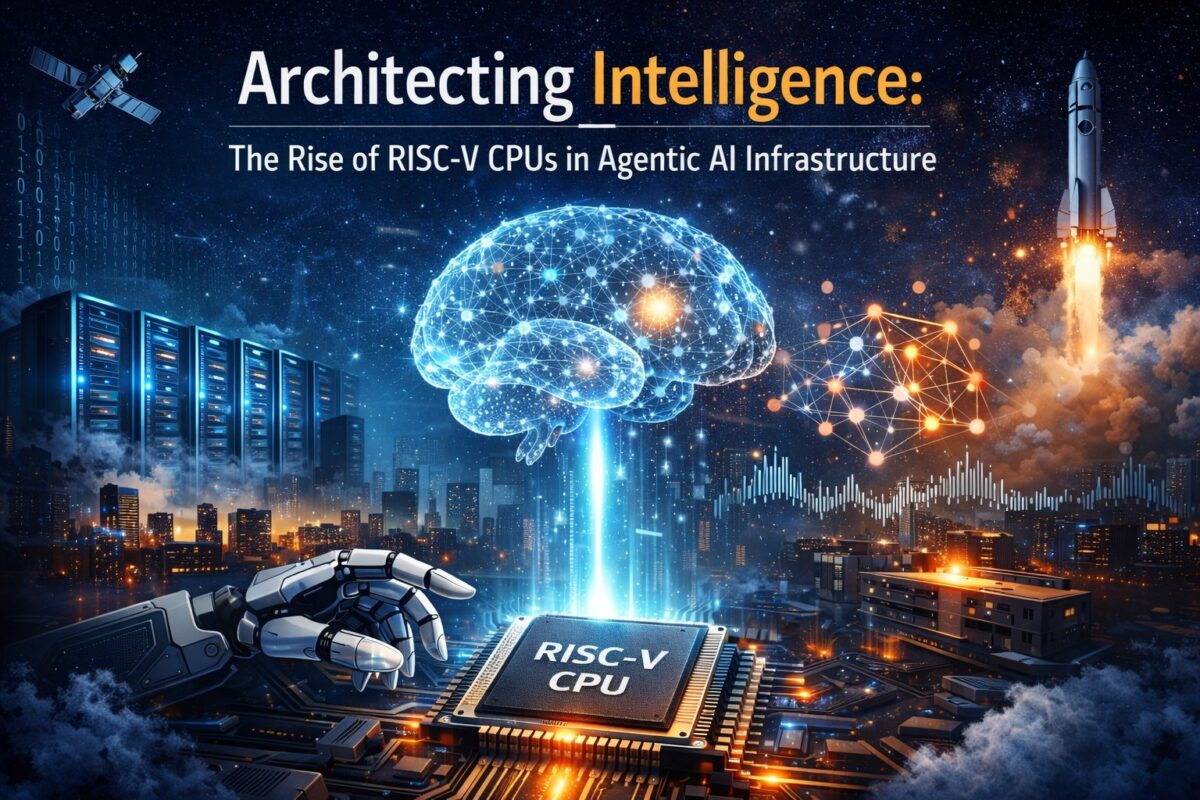
Smoke curls from a server rack in some nondescript Silicon Valley data center, where a lone RISC-V chip hums, pretending it’s ready to boss around the AI agents of tomorrow.
SiFive’s $400 million Series G round — valuing them at $3.65 billion — screams RISC-V CPUs in agentic AI infrastructure. But let’s not pop the champagne yet. This cash is meant to juice up CPU IP, software tweaks, and hyperscale rollouts. Hyperscalers love custom silicon, sure. Problem is, RISC-V’s been promising the moon for years, and we’re still waiting for liftoff.
Look, GPUs crush tensor math. Fine. Everyone knows that. But agentic AI? Those squishy systems with loops chatting to tools, making decisions on the fly — they need CPUs for the messy control flow. Scheduling. Context switches. RISC-V’s modular vibe lets you bolt on vector extensions, tweak for orchestration. Neat on paper.
Why Bet on RISC-V CPUs for Agentic AI?
Here’s the pitch: tightly knit scalar pipelines with vector units. Less data shuffling. Embedded accelerators right in the CPU fabric — no offload headaches. Ideal for AI agents flipping between reasoning and math, planning and tweaking.
Power? Massive sell. AI clusters guzzle watts like frat boys at a kegger. Legacy chips rev high clocks, burn deep pipelines. RISC-V? Right-sized, extension-packed. Better perf-per-watt. Expand clusters without begging for a nuclear plant next door.
But — and it’s a big but — software’s the real bottleneck. Linux support? Check. GPU interconnects? They’re working on it. Compilers for those fancy extensions? Still maturing. Hyperscalers won’t touch it without plug-and-play.
Short answer: because x86’s a dinosaur, ARM’s proprietary playground. RISC-V’s open. Customize accelerators, memory tricks, interconnects. Shorten design spins. Fits evolving AI chaos.
Is SiFive’s $400M Funding Actually Moving the Needle?
SiFive’s newly announced $400 million Series G financing represents a significant technical inflection point for high-performance RISC-V CPU development targeted at agentic AI data center workloads.
That’s the press release spin. Inflection point? Please. It’s funding. Vendors collaborate on extensions, tools. Open ecosystem — sounds collaborative, utopian even. Reality: fragmentation risk. Everyone adds their flavor, compatibility crumbles.
My unique take? This echoes ARM’s wild 90s days — explosive growth, but balkanized implementations led to dev hell. RISC-V could repeat that, splintering agentic AI stacks into vendor silos. Bold prediction: by 2027, we’ll see RISC-V agent runners, but x86/ARM hybrids dominate hyperscalers. SiFive’s cash buys time, not victory.
Corporate hype calls it out: “address emerging compute bottlenecks.” Bottlenecks? Try GPU monopolies and power walls. RISC-V’s no silver bullet — it’s a toolkit. Vendors like SiFive promise hyperscale enablement, but who’s buying en masse? Meta? Google? Crickets so far.
Microarchitecturally, co-design shines. Hybrid workloads — control logic woven with numerics. Cache coherence? Simplified. Latency? Slashed. For iterative AI tasks, yeah, it clicks.
Yet skepticism reigns. Traditional architectures “struggle,” they say. x86 laughs — it’s got decades of optimization. RISC-V needs killer apps, not just funding rounds.
Ecosystem openness? Double-edged. Collaboration speeds innovation. Contributions to ISAs, verifs, opts. Could rival Arm’s empire.
But here’s the dry humor: open standards birthed Linux wars. Expect RISC-V schisms — SiFive vs. whoever. Agentic AI demands unity, not tribalism.
Customer co-design trend? Hyperscalers crave it. Proprietary bits in open base. Strategic gold for task schedulers, messaging primitives.
Still, deployment’s the rub. Software maturation lags hardware dreams. Native OS, frameworks — investments help, but porting overhead bites.
Bottom line? Interconnected goals: IP push, software swell, scale-up. Addresses orchestration, efficiency, scalability in heterogeneous AI hellscapes.
Punchy truth: SiFive’s loaded now. Watch for real silicon, not slides. Agentic AI waits for no one — especially not unproven arches.
The Power Play in AI Data Centers
Scale hits power limits fast. RISC-V’s perf-per-watt edge? Undeniable on spec sheets. Workload-specific extensions sidestep clock races.
Compare: deep OoO pipelines in Intel land — power hogs. RISC-V’s leaner, meaner. Data centers expand within envelopes. Critical as inference explodes.
Dry aside: remember when everyone chased 100GHz? We got thermal throttling instead. RISC-V skips that trap.
Heterogeneous clusters — RISC-V CPUs herding GPU herds. Scheduling wins, host bottlenecks fade.
🧬 Related Insights
- Read more: Snap’s GPU Pivot: Crushing A/B Test Crunch with NVIDIA’s cuDF Magic
- Read more: NVIDIA’s Physical AI Robot Push: Breakthroughs or Bottled Hype?
Frequently Asked Questions
What is agentic AI and why does it need special CPUs?
Agentic AI means models that act autonomously — planning, using tools, iterating. GPUs flop on control flow; CPUs like RISC-V handle orchestration with low latency.
Will RISC-V replace x86 in data centers?
Not soon. It’s niche for now — agent brains. x86/ARM rule bulk compute. Fragmentation might slow it.
Is SiFive’s funding a sign RISC-V is taking off?
It’s fuel, not flight. Watch for hyperscaler wins. Hype’s thick; silicon’s thin.